This page covers the visa’s eligibility rules, the current financial requirement, how long it takes to settle, and exactly how mortgage lenders assess Spouse visa holders.
Understanding the Spouse visa
Who qualifies, the £29,000 income rule and which figure applies to you, how long the route to settlement takes, and whether your children can come too.
What is the Spouse visa?
The Spouse visa allows a foreign national who is married to, or in a civil partnership with, a British citizen or a person with settled status to live in the UK. It is part of the wider “partner route” under Appendix FM of the Immigration Rules, which also covers unmarried partners and fiancé(e)s.
Who is eligible?
To qualify, you generally need:
- You must be married to, or in a civil partnership with, a British citizen, someone with settled status (ILR), or someone with refugee or humanitarian protection status
- Both partners must be 18 or over
- The relationship must be genuine and subsisting, and you must intend to live together permanently in the UK
- You must meet the financial requirement
- You must meet the English language requirement — usually A1 at the initial application, rising as you progress through the route
- Suitable accommodation must be available without recourse to public funds
Free · 60 seconds
Check what you could borrow in 60 seconds
Answer eight questions and see an instant estimate based on your visa, your income and your deposit.
The financial requirement — the part that trips people up
As of 2026, the minimum income requirement (MIR) for most new Spouse visa applications is £29,000 gross per year, which the UK-based sponsor — or, in some cases, the couple’s combined qualifying income — must demonstrate.
| When you first applied | What you must show |
|---|---|
| On or after 11 April 2024Current rule | What you must show£29,000gross per yearThe current requirement for most new applications, up from the previous £18,600 threshold. There is no additional amount required for dependent children, unlike the old rules. |
| Before 11 April 2024 | What you must show£18,600gross per yearIf your first application was made before that date, you may still be assessed against the older threshold for extensions and settlement with the same partner. |
If your income does not meet the threshold, cash savings can be used instead. Specific savings thresholds apply and the calculation is precise, so check the current gov.uk guidance rather than working from a headline figure.
The government has been reviewing this threshold following Migration Advisory Committee recommendations for a lower figure of around £23,000–£25,000. As of mid-2026 no change has been implemented — always check gov.uk for the current position before applying.
How long does it last, and what’s the route to settlement?
The Spouse visa is granted in stages rather than one long block. The initial grant runs for 2 years and 9 months, then extends for a further 2 years and 6 months, leading to eligibility for Indefinite Leave to Remain after 5 years on the route — often called the “5-year partner route”. As with other visa categories, settlement rules are under active government review in 2026, so confirm the current timelines on gov.uk.
- Mth 0–21
Your clearest window
You are on the initial 2 year 9 month grant with 12 or more months still to run — the point at which most lenders will assess you in the normal way.
- Mth 21–33
Extension due
Under 12 months left on the first grant. Some high-street lenders pause here, but several specialist lenders on our panel are comfortable with this route’s renewal cycle.
- Mth 33–51
The window reopens
Once the 2 year 6 month extension is granted you are back above 12 months remaining, and the same lenders open up again. This is what makes the Spouse route a cycle rather than a countdown.
- Mth 51–63
Approaching settlement
You become eligible to apply for Indefinite Leave to Remain after 5 years on the route. Settlement rules are under government review in 2026 — check gov.uk before relying on a date.
Key dates
- Month 0Visa granted — an initial 2 years and 9 months
- Month 33First extension — a further 2 years and 6 months
- Month 60Five years on the route: eligible to apply for Indefinite Leave to Remain
If you are on the 10-year route
Not everyone is on the 5-year route. A separate 10-year partner route applies where someone cannot meet every requirement of Appendix FM but has human-rights grounds to remain in the UK. It is granted in 30-month stages and leads to settlement after 10 years rather than 5, which changes the mortgage picture — tell your adviser which route you are on.
Can my children come too?
Yes. Dependent children under 18 can usually be included in the same application, or apply separately to join you later.
Getting a mortgage on a Spouse visa
Whether to apply jointly or on your own, how much you could borrow, the documents lenders ask for, and the three things that most often get in the way.
Can I get a mortgage on a Spouse visa?
Yes. If you are applying jointly with a British citizen or settled partner, most mainstream lenders will assess the application in the normal way, using both incomes together. If you are applying alone — or your partner also holds a visa — you will need a lender experienced with visa-holder applications, which is exactly what we specialise in.
Joint vs. sole applications
Both are real options with real lenders behind them. Which one gets you the better outcome depends on your partner’s status, your two incomes and the rate you are chasing.
Applying jointly
Generally the most straightforward route, since lenders can rely on your partner’s status as well as your combined income.
- Who it suits
- You and a partner who is a British citizen or has settled status.
- Lender pool
- Most mainstream lenders, assessing the application in the normal way.
- Income assessed
- Both incomes combined, typically at 4–4.5× the total.
Applying on your own
Also accepted by lenders on our panel, assessed on your own income, employment and visa status.
- Who it suits
- You alone, or a couple where your partner also holds a visa.
- Lender pool
- Specialist lenders on our panel who assess visa holders individually.
- Income assessed
- Your income alone, at the same affordability multiples as a joint application.
How much can I borrow?
Joint applications typically use your combined income at 4–4.5×. Sole applications follow the same affordability multiples, applied to your income alone. Use our eligibility calculator for an instant estimate.
Documents you’ll need
- Passport and current BRP or eVisa share code
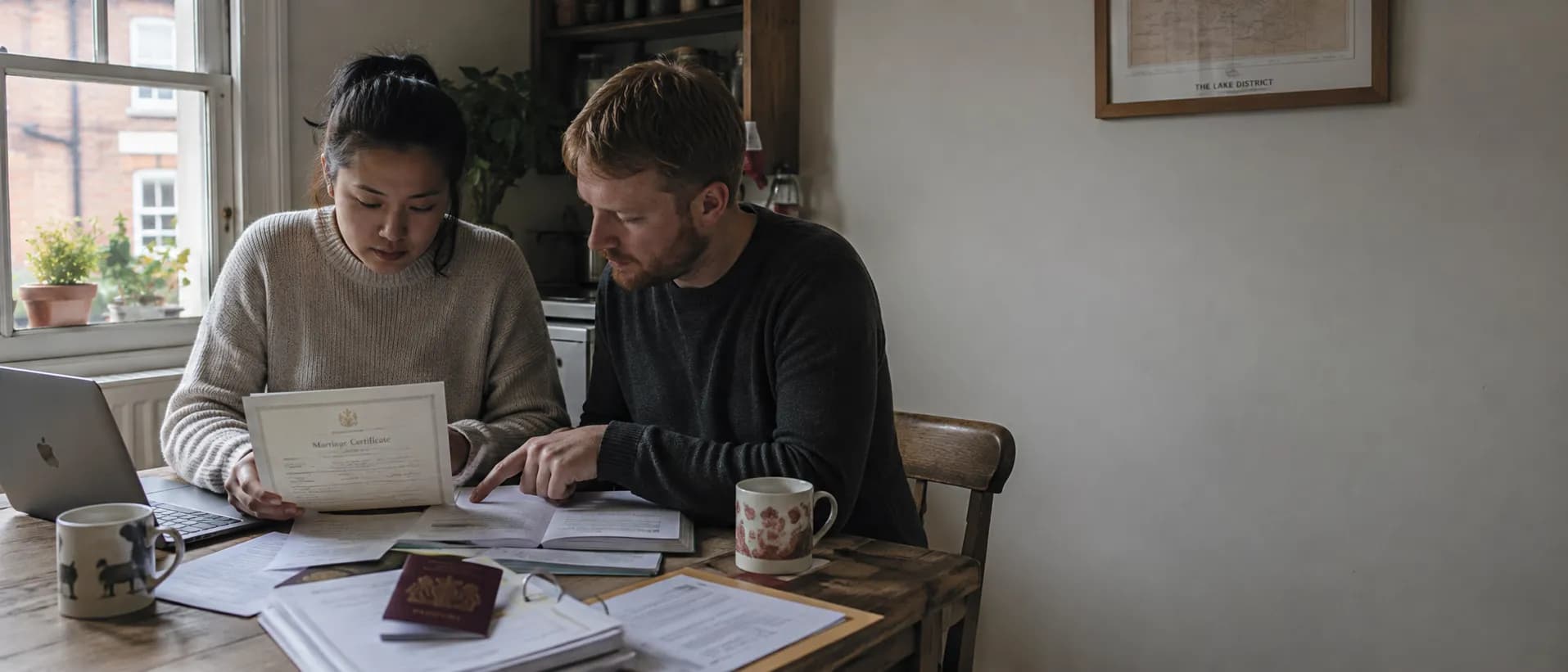
- Marriage or civil partnership certificate
- Proof of your partner’s status — a British passport, or BRP/ILR evidence
- 3–6 months of payslips and bank statements
- Proof of deposit
- Your UK credit report — check yours with checkmyfile(opens in a new tab)
Common challenges — and how we solve them
“Should we apply jointly, or should I apply on my own?”
We will talk through which route gets you the best rate and the largest loan for your circumstances before you commit to either.
“My deposit is a gift from family overseas.”
Acceptable in most cases, provided there is a clear, documented paper trail. We will tell you exactly what evidence your lender wants before you move the money.
“My visa is up for renewal before long.”
We know which lenders are comfortable with the standard 2 year 6 month extension cycle on this route, so a renewal on the horizon does not have to stop the application.
Frequently Asked Questions
What is the minimum income requirement for a UK Spouse visa in 2026?
£29,000 gross per year for most new applications, though this can be met through savings instead of income in some circumstances, and different rules apply to applicants who first applied before 11 April 2024.
Can I get a mortgage without my British partner applying with me?
Yes, you can apply solely on your own income, though joint applications often unlock better rates and larger loan sizes since both incomes and your partner’s status can be used.
Do I need Indefinite Leave to Remain to buy a house on a Spouse visa?
No. Lenders on our panel offer mortgages to Spouse visa holders without ILR, based on income, relationship evidence, and visa status.
Can gifted deposits from overseas family be used?
Yes, in most cases, provided you can show a clear audit trail confirming the funds are a genuine, non-repayable gift, in line with UK anti-money-laundering requirements.
How long until I can apply for Indefinite Leave to Remain on a Spouse visa?
Typically after 5 years on the partner route, though settlement rules are under government review in 2026 — check gov.uk for the current position before relying on a specific timeline.
Still have a question? Read our full FAQs or ask us directly.
Further reading